

 09-Jun--2026
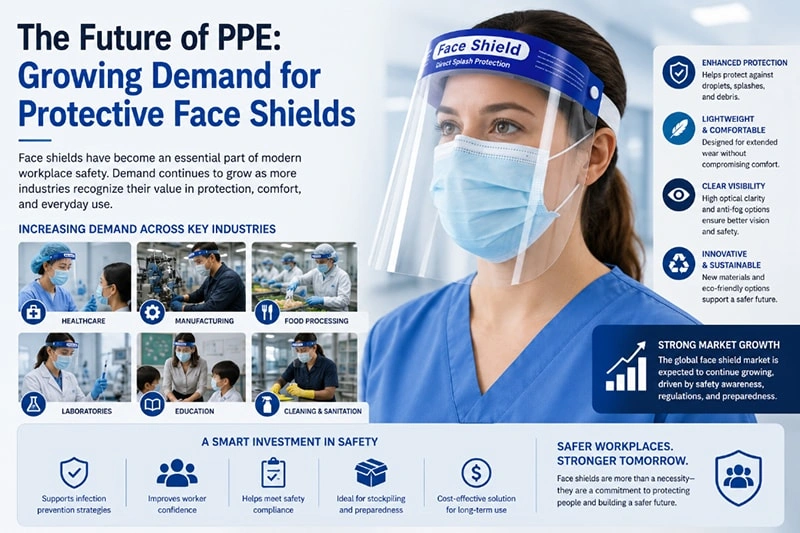
As workplace safety standards continue to evolve, protective face shields are emerging as a key component of modern personal protective equipment (PPE). Once primarily associated with healthcare settings, face shields are now being adopted across a growing range of industries seeking to enhance employee safety, improve compliance, and strengthen preparedness for future health and workplace challenges.
A Changing PPE Landscape
The global PPE market has undergone significant transformation over the past several years. Organizations are no longer viewing protective equipment solely as an emergency resource but as an essential part of everyday risk management.
Among the products experiencing sustained demand, protective face shields have gained attention for their versatility, ease of use, and ability to provide additional facial protection in environments where exposure to droplets, splashes, or airborne debris may occur.
Growing Demand Across Multiple Industries
While healthcare remains a major user of face shields, demand is expanding in sectors such as:
· Manufacturing
· Food processing
· Pharmaceutical production
· Laboratory research
· Education and training
· Cleaning and sanitation services
· Public transportation
Employers are increasingly incorporating face shields into workplace safety programs to help reduce occupational risks and improve worker confidence.
Supporting Infection Prevention
In healthcare and public-facing environments, face shields continue to play an important role in infection prevention strategies.
When used alongside masks or respirators, face shields help provide an additional barrier against:
· Respiratory droplets
· Fluid splashes
· Accidental contact with the face
· Exposure to potentially infectious materials
This layered approach to protection has become a standard practice in many healthcare and laboratory settings.
Innovation Driving Adoption
Manufacturers are investing in new materials and designs to improve both comfort and performance. Recent innovations include:
· Lightweight construction for extended wear
· Anti-fog technology
· Enhanced optical clarity
· Adjustable headbands
· Extended face coverage
· Environmentally conscious materials
These improvements are helping organizations balance protection with user comfort, particularly for employees who wear PPE for long periods.
Workplace Safety and Regulatory Compliance
As occupational safety regulations continue to develop, businesses are placing greater emphasis on selecting PPE that meets industry standards while addressing specific workplace hazards.
Face shields are increasingly recognized as an effective solution for environments involving:
· Splash risks
· Chemical handling
· Flying particles
· Food safety requirements
· Infection-control procedures
Their ability to complement other protective equipment makes them a valuable part of comprehensive safety programs.
Preparing for the Future
Many organizations are also strengthening PPE stockpiles as part of broader preparedness initiatives. Lessons learned from recent global health events have encouraged businesses, hospitals, and government agencies to maintain reliable inventories of critical protective equipment.
Face shields are expected to remain a key element of these preparedness strategies due to their versatility and broad range of applications.
Outlook
Industry experts anticipate continued growth in demand for protective face shields over the coming years. As employers prioritize worker safety, operational resilience, and regulatory compliance, face shields are becoming more than a temporary protective measure—they are evolving into a long-term component of workplace safety and infection prevention programs.
The future of PPE will likely be defined by innovation, adaptability, and preparedness, with protective face shields playing an increasingly important role across healthcare, industrial, and public service sectors.
