

 20-Oct--2026
Buying masks, gowns or gloves is easy. Buying them from a supplier who will still be compliant in two years is harder. Most buyers compare price and a folder of certificates. That is not enough: certificates are easy to fake, and price is easy to cut by using thinner material.
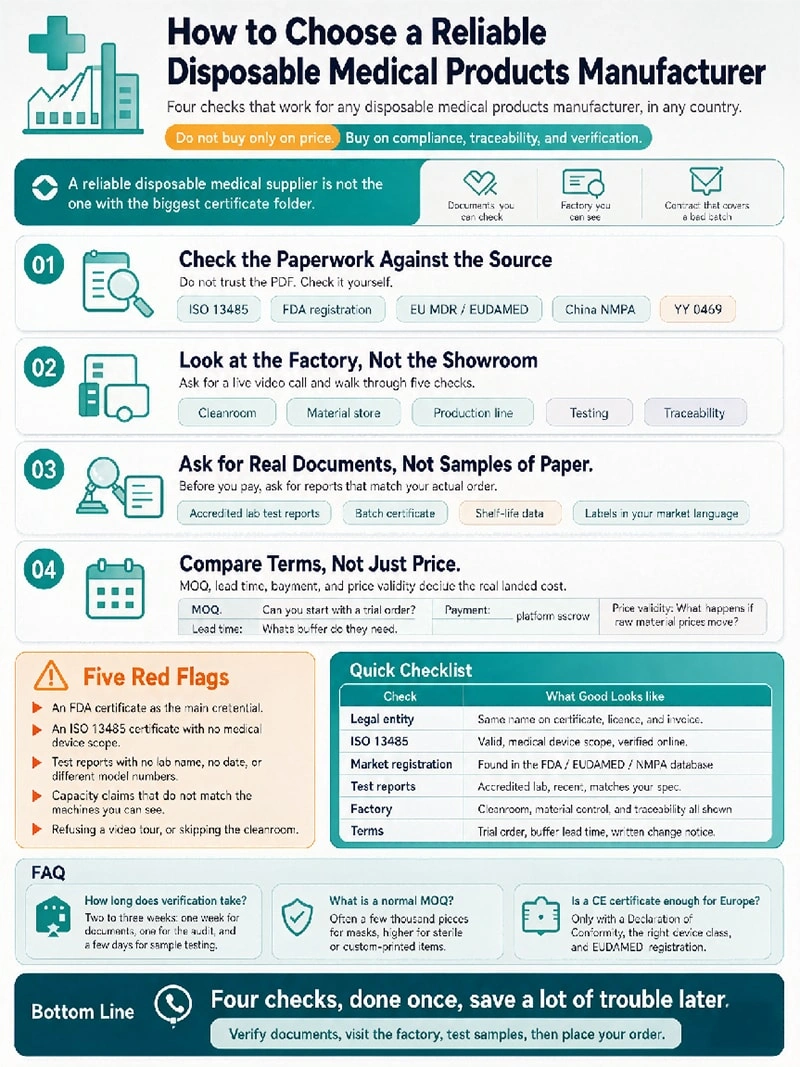
Here are four simple checks that work for any disposable medical products manufacturer, in any country.
1. Check the paperwork against the source
Do not trust the PDF. Check it yourself.
· ISO 13485 means the factory has a quality system for medical devices. Read the scope line: it must name medical devices or your product, not just "non-woven products".
· US market: the factory must be registered with the FDA and list the device. Look it up in the FDA database. The FDA does not issue "FDA certificates" — if a supplier shows you one, be careful.
· EU market: they need a Declaration of Conformity, the correct device class, and registration in EUDAMED. Non-sterile masks can be self-declared, but the technical file must exist.
· China market: NMPA registration, with YY 0469 for surgical masks.
If you are buying from a medical consumables manufacturer in China, add one more question: how many shipments have they sent to your country in the last three years? Export experience is what keeps your documents out of customs trouble.
2. Look at the factory, not the showroom
Ask for a live video call and walk through in this order:
1. Cleanroom— what class, and can they show pressure logs?
2. Material store — certificates for each roll of melt-blown fabric.
3. Production line — count the machines, then ask them to explain the capacity maths.
4. Testing — how often do they test filtration, and who signs off?
5. Traceability — pick a carton and ask them to trace it back to the fabric roll.
If they skip a section, ask why. A disposable medical products factory that cannot show these five things is usually a trading office, not a factory.
3. Ask for real documents, not samples of paper
Before you pay, ask the disposable medical products factory for test reports from an accredited lab, a batch certificate for the actual production lot, shelf-life data, and labels in your market's language.
Also ask for one written promise: they will tell you before changing material, machine or sub-supplier. Many buyers skip this, then discover the second order is not the same as the first.
4. Compare terms, not just price
· MOQ — can you start with a trial order?
· Lead time — what buffer do they normally need?
· Payment — can you use platform escrow?
· Price validity — how long is the quote valid, and what happens if raw material prices move?
Five red flags
1. An "FDA certificate" as the main credential.
2. An ISO 13485 certificate with no medical device scope.
3. Test reports with no lab name, no date, or different model numbers.
4. Capacity claims that do not match the machines you can see.
5. Refusing a video tour, or skipping the cleanroom.
Quick checklist
Every disposable medical products manufacturer should pass all six rows:
Check | What good looks like |
Legal entity | Same name on certificate, licence and invoice |
ISO 13485 | Valid, medical device scope, verified online |
Market registration | Found in the FDA / EUDAMED / NMPA database |
Test reports | Accredited lab, recent, matches your spec |
Factory | Cleanroom, material control and traceability all shown |
Terms | Trial order, buffer lead time, written change notice |
FAQ
1. How long does verification take? Two to three weeks: one week for documents, one for the audit, and a few days for sample testing.
2. What is a normal MOQ? Often a few thousand pieces for masks, higher for sterile or custom-printed items. Always separate trial quantity from production MOQ.
3. Is a CE certificate enough for Europe? Only with a Declaration of Conformity, the right device class and EUDAMED registration. Ask to see all three.
4. Can I buy from a trading company? Yes, if they audit the factory and take responsibility in writing. Most do not. A reliable disposable medical supplier will tell you which factory makes your order — a trader usually will not.
Bottom line
A reliable disposable medical supplier is not the one with the biggest certificate folder. It is the one whose documents you can check, whose factory you can see, and whose contract covers a bad batch. Four checks, done once, save a lot of trouble later.
